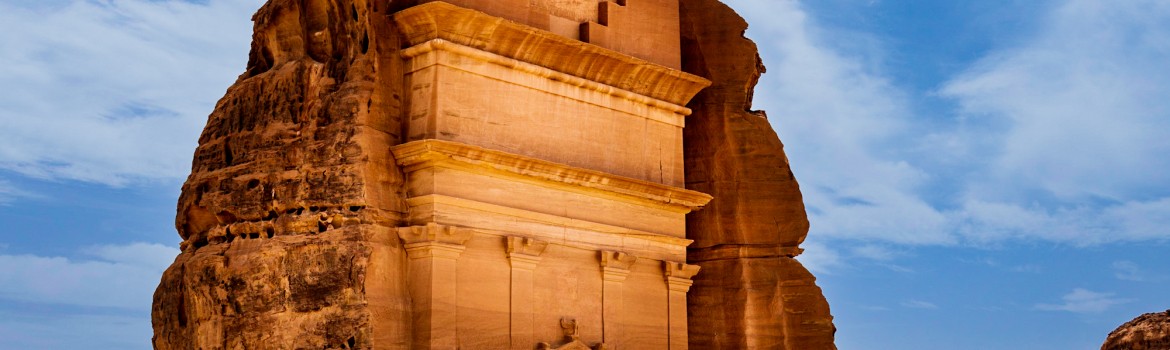
Mada'in Saleh (Arabic: مدائن صالح, madāʼin Ṣāliḥ), also called Al-Hijr or Hegra is a pre-Islamic archaeological site located in the Al-Ula sector, within the Al Madinah Region of Saudi Arabia. A majority of the vestiges date from the Nabatean kingdom.
The delicate details on the entrance portals and the smooth surfaces of its 111 tomb façades reflect the great skills of the masons of their time. The splendor of the natural setting here must have reminded the Nabataeans of their capital, Petra, hewn into the rosey sandstone cliffs to the north in modern-day Jordan. It is no wonder that they chose this very spot to build their second city, Hegra. Based on the many dated tomb inscriptions, Hegra thrived between 1 BCE -74 CE.
The Nabataeans began as pastoral nomads, raising their sheep, goats, and camels in the desert as so many other Arabian tribes have done through the millennia. They also practiced oasis agriculture, utilizing a set of wells dug into the rock. Their origin is uncertain, but there is a strong possibility that they came from the Hejaz region of northwest Saudi Arabia.
According to the Islamic text, the Thamudis, who would carve out homes in the mountains, were punished by Allah for their persistent practice of idol worship and for conspiring to kill the prophet whom He sent, the non-believers being struck by an earthquake and lightning blasts.Thus, the site has earned a reputation down to contemporary times as a cursed place— an image which the national government is attempting to overcome as it seeks to develop Mada'in Saleh, officially protected as an archaeological site since 1972, for its tourism potential.
In 2008, for its well-preserved remains from late antiquity, especially the 131 rock-cut monumental tombs, with their elaborately ornamented façades, of the Nabatean kingdom, UNESCO proclaimed Mada'in Saleh as a site of patrimony, becoming Saudi Arabia's first World Heritage Site.



 facebook
 twitter
 google+
 instagram
 flickr
 tumblr
 500px
500px
 Pinterest
 YouTube
 Tik Tok
 Threads