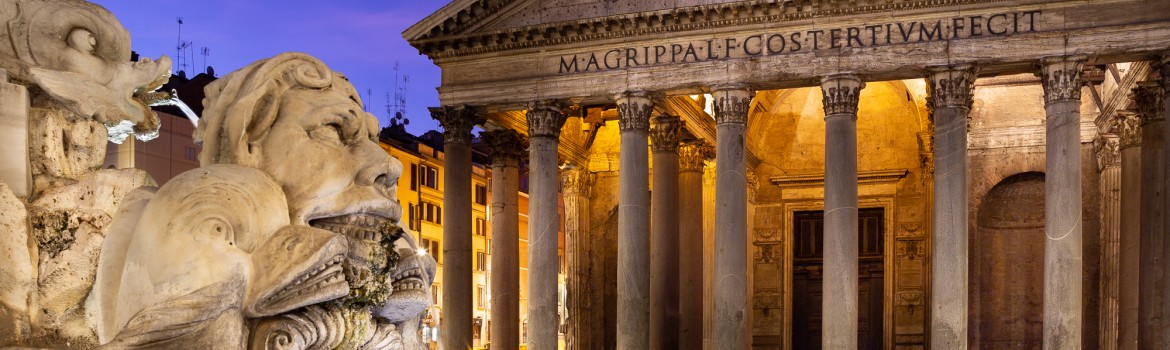
The Roman Pantheon situated in Rome, Italy, is the most preserved and influential building of ancient Rome. It is a Roman temple dedicated to all the gods of pagan Rome. As the brick stamps on the side of the building reveal it was built and dedicated between A.D 118 and 125.
The emperor Hadrian (A.D 117-138) built the Pantheon to replace Augustus’ friend and Commander Marcus Agrippa’s Pantheon of 27 B.C. which burnt to the ground in 80 A.D.
When approaching the front of the Pantheon one can see the inscription above still reads in Latin the original dedication by Marcus Agrippa. The inscription reads:
"M. AGRIPPA.L.F.COSTERTIUM.FECIT”
“Marcus Agrippa son of Lucius, having been consul three times made it”.
Despite all the marvelous building projects that the emperor Hadrian produced during his reign, he never inscribed his name to any, but one, the temple of his father Trajan. That is why the Roman Pantheon bears the inscription of Marcus Agrippa, and not the emperor Hadrian.
The Italian kings Vittorio Emanuele II and Umberto I as well as the famous Renaissance painter Raphael and his fiancée are buried in the Pantheon. It is a wonderful example of second century Roman architecture. It boasts mathematical genius and simple geometry that today still impresses architects and amazes the eyes of casual viewers.



 facebook
 twitter
 google+
 instagram
 flickr
 tumblr
 500px
500px
 Pinterest
 YouTube
 Tik Tok
 Threads